



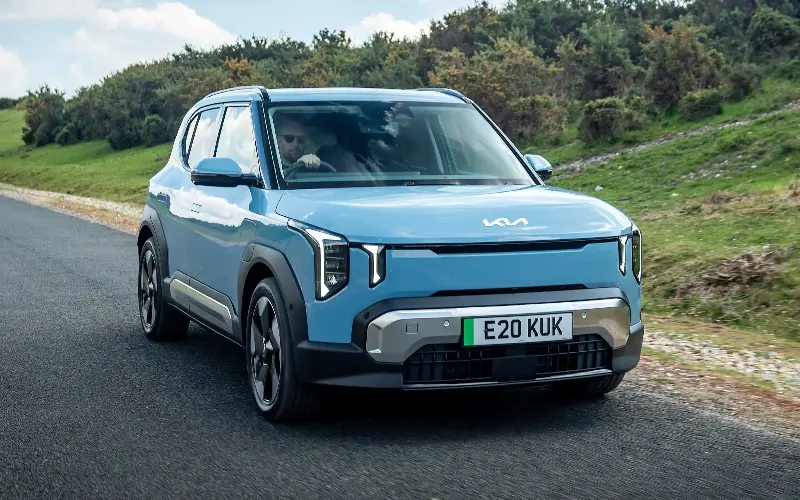
When it comes to new ideas in the electric car world, if you aren’t first you need to be outstanding. That’s what Kia hopes for the EV2, its smallest battery-electric product, effectively a shrunk-washed version of its well-received EV5 family car.
While not exactly an ultra-compact urban runaround, this 4.06-metre-long, 1.8-metre-wide car joins a class of not quite B-sector (super-mini) nor not quite C-sector (family-size) cars. It faces stiff competition not only from the Renault R4, the Skoda Epiq or Volkswagen ID Cross, but also from sister company Hyundai’s Inster, which is marginally smaller.
I have rather a soft spot for such tall yet compact vehicles, although they never seem to hit the mark and are often too expensive for what is avowedly non-premium family transport.
Simple and useful
First the styling, reminiscent of the soft-edged van shape of the 2009-2017 Skoda Yeti. The EV2 is all post-modern Postman Pat, to the extent that you look in vain for a robot black-and-white cat. But the shape is so appealing, as simple and useful as a clothes peg and soft and unthreatening as a pair of slippers, just right for a car designed to do an unglamorous job reliably and economically.
Inside it’s intelligently designed, although not as practical as Kias used to be. The curved glass fascia is three screens in one: the instrument binnacle, clear but conveying too much information, a tiny screen (obscured by your left hand on the steering wheel) displaying the heating and ventilation settings; and the main touchscreen which has clear graphics.
Thankfully the heater controls are mostly swish piano-key switches underneath the central screen and there’s even a barrel rotary volume control for the multi-media. The steering wheel contains a couple of fistfuls of controls including a simple method to turn off the lane-keeping assistance, although sadly you can’t turn off the now-mandated driver-monitoring system, which gets cross if you dare even scratch your nose.
The rest feels well thought out, though. There’s lots of room for rear-seat passengers and the packaging is well done, so when you fold the rear seat backs the base of the boot floor is flat.
And while the 362-litre load area (1,201 litres with the rear seat backs folded) isn’t huge for the class, there’s space under the floor for the charging cables. Another neat touch is the USB sockets in the back of the front seats so passengers in the rear can easily charge their phones.
At the front the high-set seats are comfortable and pleasantly squashy. There’s loads of storage space and the door pockets are decently sized.
Under the skin
This £26,995 First Edition model has a 42.2kWh lithium polymer battery weighing 325kg (these cells have a gel-type rather than a liquid electrolyte and can be made into a variety of shapes), providing a range of 190 miles. A long-range version with a 61kWh lithium-ion nickel-manganese-cobalt (NMC) cell and a range of up to 281 miles is offered in other models.
The motor is a permanent-magnet synchronous AC type delivering 144bhp and 184lb ft of torque. The operating electronics operate at 400 volts, which helps with energy flows and allows high-current charging of up to 118kW. The EV2 also supports vehicle-to-grid/vehicle-to-load tech, so you can use its battery to power home appliances or while camping.
The all-independent suspension features MacPherson struts at the front and a multi-link rear. This launch model has 18in wheels and tyres; base models have 17in wheels and the high-spec GT Line models have 19in items.
On the road
The initial impression of the EV2 is of a finessed drivetrain, with responsive steering and a gambolling approach to medium-speed travel. It feels spacious, providing a good view of the road ahead.
It’s brisk rather than fast, but more than capable of feisty acceleration from traffic lights. The efficiency is impressive, too. Not hanging around on mostly A-roads during very hot weather, I achieved 4.0 miles per kWh against the quoted 4.08 miles per kWh, which equates to a range of just under 170 miles.
All good, then, until the wheels meet a less-than-perfect road surface, whereupon the EV2 bounces and heaves over longer bumps and crashes into anything with a sharp edge. Even given the poor state of British roads, this isn’t good and it overshadows virtually everything else. Broken road edges? The car wobbles from side to side. Peeling road surface? You’ll know it before you see it.
The brakes are good and the pedal has great progression, although the suspension dive during hard retardation is disconcerting. The steering is better than most, but the harsh ride transcends the more positive traits.
The Telegraph verdict
Prices range from £24,245 to £37,045 (although Kia is offering a £3,750 early-order discount against confirmation of a government Electric Vehicle grant). In other words, you need to study the brochure with care. Particularly so when you consider that the cheapest model, the £24,245 Air, also has the long-range 61kWh battery, a range of 281 miles and probably rides a bit better thanks to its 17in wheels and tyres. As is often the case with electric vehicles (EVs), the cheapest version might be the best option.
There’s a plethora of accomplished rivals in this sector and the EV2’s titchy boot space and parlous ride quality become an issue; I simply cannot award decent marks to a car that prioritises passengers over load space then jiggles them around until their fillings loosen.
The facts
On test: Kia EV2 First Edition 42.2kWh front-wheel drive
Body style: five-door crossover
On sale: now (other models arrive soon)
How much? from £24,245 to £37,045 (£26,995 as tested)
How fast? 100mph, 0-62mph in 8.7sec
How efficient? from 4.08m/kWh (4.0m/kWh on test)
Powertrain: 42.2kWh gross lithium-ion NMC battery, front-mounted AC synchronous permanent magnet AC motor with step-down gearing, front-wheel drive
Range: 190 miles (WLTP Combined), 169 miles on test
Charging: 10-80 per cent in 42 minutes on 50kW DC charger, 10-100 per cent in 5hr 10min on 7.4kW household wallbox
Maximum power/torque: 144bhp/184 lb ft
CO2 emissions: 0g/km (tailpipe), 24.4g/km (CO2 equivalent well-to-wheel)
VED: £10 first year, then £200
Warranty: seven years/100,000 miles
The rivals
Skoda Epiq, from £24,995
Early reports are of a fine-riding and spacious small EV (length 4,171mm) using a selection of Volkswagen Group parts and drivetrains, with a choice of 37 or 52kWh batteries.
MG4, from £29,930
One of the UK’s most popular electric vehicles among private buyers, with rear-wheel drive and a good chassis balance it’s good to drive, too. The switchgear, touchscreen and seats are much improved.